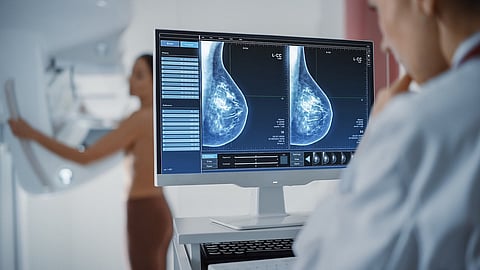

THURSDAY, July 2, 2026 (HealthDay News) -- Artificial intelligence-based risk scores from screening mammograms increase over time among women who develop cancer, and remain stable among women who remain cancer-free, according to a study published online June 23 in Radiology.
Constance D. Lehman, M.D., Ph.D., from Massachusetts General Hospital in Boston, and colleagues conducted a multisite retrospective cohort study involving women who underwent screening mammography between January 2009 and December 2019. A total of 817 women diagnosed with invasive cancer or ductal carcinoma in situ within one year of the index examination were compared with 53,197 cancer-free controls. Continuous five-year risk scores were generated by a validated image-only deep learning model.
The final study cohort included 158,807 screening mammograms from 54,014 women. The researchers found that the median risk score increased from 2.1 six years before diagnosis to 6.6 at the index examination among women who developed cancer. Stable scores were seen for women who were cancer-free (range, 1.8 to 2.2). Scores increased over time in the cancer group in longitudinal models (slope, 1.13 per year), while minimal changes were seen in scores in cancer-free controls (slope, 0.09 per year). Consistent results were seen across subgroups.
"We observed clinically relevant differences in risk trajectories between women who did and did not develop cancer," Lehman said in a statement. "The increase in scores among cancer patients was detectable as early as six years prior to diagnosis and became more pronounced over time."
Several authors disclosed financial ties to the biopharmaceutical industry.
