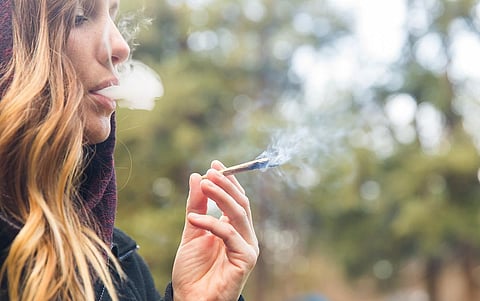

TUESDAY, Nov. 25, 2025 (HealthDay News) -- After smoking cannabis, individuals consume less alcohol, according to a study published online Nov. 19 in The American Journal of Psychiatry.
Jane Metrik, Ph.D., from the Center for Alcohol and Addiction Studies at the Brown University School of Public Health in Providence, Rhode Island, and colleagues examined dose-dependent acute effects of delta-9-tetrahydrocannabinol (THC) on alcohol craving and consumption. The analysis included 138 participants reporting heavy alcohol use and cannabis use two or more times weekly who were randomly assigned to smoke cannabis cigarettes containing 7.2, 3.1, or 0.03 percent (placebo) THC, followed by exposure to neutral and personalized alcohol cues.
The researchers observed no significant effects of cannabis on Alcohol Craving Questionnaire-Short Form, Revised, ratings after smoking and during alcohol cue exposure. However, the 7.2 percent THC reduced alcohol urge immediately after smoking. After smoking cannabis with 3.1 or 7.2 percent THC, participants consumed significantly less alcohol (19 and 27 percent, respectively).
"What we found was consistent with this idea of the substitution effect popularized by the California sober trend," Metrik said in a statement. "Instead of seeing cannabis increase craving and drinking, we saw the opposite. Cannabis reduced the urge for alcohol in the moment, lowered how much alcohol people consumed over a two-hour period, and even delayed when they started drinking once the alcohol was available."