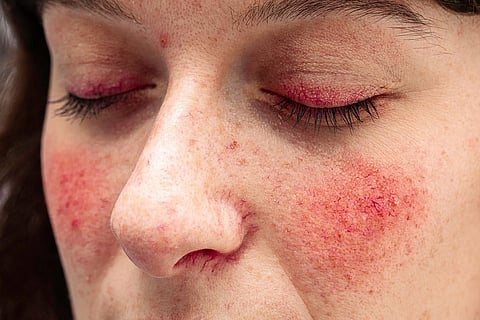

WEDNESDAY, Oct. 14, 2026 (HealthDay News) -- A device-free, on-demand active acupressure intervention offers clinical benefits for patients with rosacea when combined with pharmacotherapy, according to a study published online Oct. 14 in JAMA Dermatology.
Bingyang Xu, M.D., from The Second Affiliated Hospital of Xi'an Jiaotong University in China, and colleagues examined the clinical efficacy of device-free auricular acupressure for rosacea in a single-center, sham-controlled trial including 204 patients with rosacea who were receiving standard first-line treatment. The active acupressure group (102 participants) received a Vaccaria segetalis seed on the bilateral cavum conchae (innervated by the auricular vagus branch), while the sham group (102 participants) received a seed on the auricular tubercle superior margin (pure somatosensory innervation); acupressure was performed three times daily for 30 seconds, with extra pressing during acute flare-ups.
The researchers found that the active acupressure group had a higher Investigator Global Assessment (IGA) success rate (score of 0 or 1) at week 8 (56.9 versus 35.3 percent; relative risk, 1.61; number needed to treat, 5). In the active acupressure group, serum cathelicidin antimicrobial peptide, calcitonin gene-related peptide, tumor necrosis factor α, and interleukin-6 levels decreased more significantly. The immediate vascular improvement rate was significantly higher with active acupressure (59.3 versus 7.4 percent). The active acupressure group maintained significantly lower IGA and Clinical Erythema Assessment scores at week 20. There were no serious adverse events.
This intervention "exerted dual effects, including immediate symptomatic relief and long-term neuroimmunomodulation, and addressed an unmet need for prompt active intervention during acute rosacea flares," the authors write.
