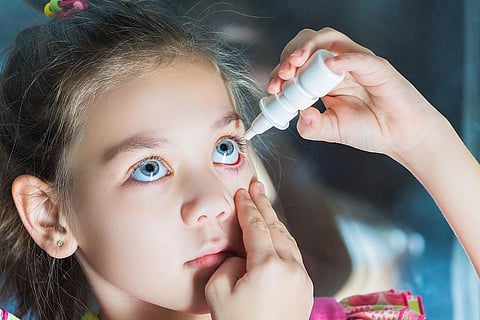

MONDAY, June 15, 2026 (HealthDay News) -- Low-concentration atropine eye drops significantly reduce progression of myopia in children, according to a study published online June 11 in The BMJ.
Augusto Azuara-Blanco, M.B.B.S., Ph.D., from the Centre for Public Health at Queen's University Belfast in the United Kingdom, and colleagues conducted a multicenter superiority trial involving 289 children aged 6 to 12 years with myopia between −0.50 and −10.0 diopters (D). Participants were allocated to receive one eye drop of preserved atropine 0.01 percent or placebo daily for two years (192 and 97, respectively).
Overall, 235 participants completed the study; primary outcome data were available for 230. The researchers found that for reducing myopia progression, atropine eye drops were more effective than placebo (mean difference, 0.33 D). No differences were seen in a prespecified subgroup analysis according to age, ethnicity, sex, or myopia severity. Compared with the placebo group, changes in central axial length were significantly lower in the atropine group (mean difference, 0.14 mm). No differences were seen in other secondary outcomes apart from pupil diameter, which was greater in the atropine group (0.36 mm). The frequency of adverse events did not differ between the groups, nor did tolerability measures.
"Low concentration 0.01 percent atropine treatment was well tolerated and effective and should be considered as an alternative to manage myopia progression," the authors write.
Several authors disclosed ties to the biopharmaceutical and vision industries.
