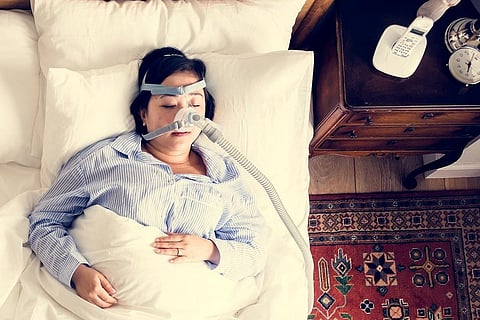

TUESDAY, June 2, 2026 (HealthDay News) -- For adults with obstructive sleep apnea (OSA), early nonadherence to continuous positive airway pressure (CPAP) does not predict treatment abandonment, according to a study presented at the American Thoracic Society 2026 International Conference, held from May 15 to 20 in Orlando, Florida.
Dennis Hwang, M.D., from Kaiser Permanente Southern California, and colleagues examined long-term use and rates of CPAP treatment abandonment, regardless of early usage levels. All adult patients with OSA dispensed CPAP between 2020 and 2023 within Kaiser Permanente Southern California were analyzed; those with at least one recorded episode of device usage during the one-year period after CPAP dispensation were stratified by 90-day Centers for Medicare & Medicare Services (CMS) adherence status.
Overall, 49.0 percent of the 132,492 patients met 90-day CMS adherence, increasing to 53.5 percent among those aged 65 years or older. The researchers observed associations for younger age, female sex, non-White race/ethnicity, lower socioeconomic status, and less OSA severity with failure to meet CMS adherence. Thirty-six percent of patients not meeting CMS adherence still used CPAP at month 12. Mean use in this group was 197 ± 160 min/night, with at least four hours for 42.9 ± 36.0 percent of nights. Of all patients who were CMS nonadherent, 20.9 and 13.6 percent used CPAP at least two and at least four hours/night, respectively, during month 12; usage was even higher among those aged 65 years or older: 23.3 and 16.5 percent at least two and at least four hours/night, respectively.
"These findings challenge a long-standing assumption in clinical practice and policy," Hwang said in a statement. "The scale of continued use we observed in those that did not initially meet Medicare adherence was striking."
