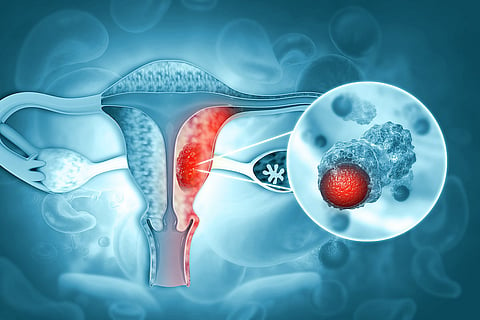

TUESDAY, June 23, 2026 (HealthDay News) -- A quick optical biopsy using optical coherence tomography (OCT) may improve endometrial cancer screening, according to a study published online June 3 in npj Imaging.
Sanskar Thakur, from Washington University in St. Louis (WashU), and colleagues investigated catheter-based 3D OCT integrated with functional, structural, and radiomic feature analysis for noninvasive endometrial assessment in ex vivo specimens. The analysis included 57 intact posthysterectomy uterine specimens spanning normal endometrium, benign conditions, high-risk endometrial intraepithelial neoplasia, and endometrial cancer.
The researchers found that an imaging feature extraction pipeline and a machine learning model to categorize the results into normal and benign or precancer and cancer using 26 extracted imaging features demonstrated exploratory sensitivity and specificity of 94 percent and 87 percent, respectively. A cross-validated Logistic Regression Classifier yielded sensitivity and specificity of 91 percent and 83 percent, respectively.
"Current endometrial biopsy practice has an estimated false-negative rate of about 10 percent (approximately 90 percent sensitivity), largely due to sampling limitations and interpretive variability," Quing Zhu, also from WashU, said in a statement. "With our three-dimensional OCT imaging system combined with machine learning, we can image the entire endometrial cavity in two to three seconds and may have a potential to achieve higher sensitivity than random biopsy sampling."
