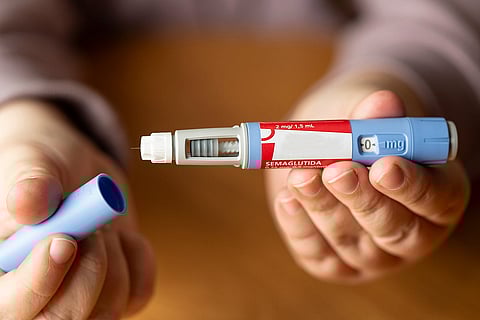

MONDAY, March 9, 2026 (HealthDay News) -- The use of glucagon-like peptide-1 (GLP-1) receptor agonists is associated with reduced risks for developing substance use disorders (SUDs), according to a study published online March 4 in The BMJ.
Miao Cai, Ph.D., from the VA Saint Louis Health Care System, and colleagues examined whether initiation of GLP-1 receptor agonists is associated with a reduced risk for incident SUDs in people with no history of SUD (protocol 1) or with a reduced risk for SUD-related adverse clinical outcomes among people with a preexisting SUD (protocol 2). Seven trials were included for each incident SUD outcome (protocol 1), and one trial was included for adverse outcomes in people with preexisting SUD (protocol 2).
The primary trial of protocol 1 included 524,817 initiators of GLP-1 receptor agonists or sodium-glucose cotransporter-2 (SGLT-2) inhibitors (124,001 and 400,816, respectively). Protocol 2 included 16,768 GLP-1 receptor agonist initiators and 64,849 SGLT-2 inhibitor initiators. The researchers found that GLP-1 receptor agonist initiation was associated with a reduced risk for disorders related to alcohol use, cannabis use, cocaine use, nicotine use, opioid use, and other SUDs compared with initiation of SGLT-2 inhibitors (hazard ratios, 0.82, 0.86, 0.80, 0.80, 0.75, and 0.87, respectively) and with a reduced risk for the composite outcome of all incident SUDs (hazard ratio, 0.86). GLP-1 receptor agonist initiation was associated with a reduced risk for SUD-related emergency department visits, SUD-related hospital admissions, SUD-related mortality, drug overdose, and suicidal ideation or attempt (hazard ratios, 0.69, 0.74, 0.50, 0.61, and 0.75, respectively) among people with preexisting SUDs.
"Our results show that GLP1 receptor agonist-related agonism may prevent addiction phenotypes across all major drug classes," the authors write.
One author disclosed ties to Pfizer.
