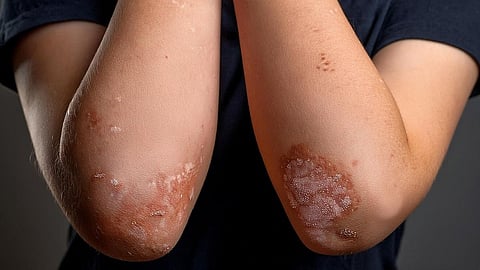

TUESDAY, June 23, 2026 (HealthDay News) -- Higher psoriasis (PsO) disease activity is independently associated with impairment in specific sleep domains, but not global sleep quality, according to a study published online May 29 in the Journal of Clinical Medicine.
Damiano Currado, M.D., from the University of Rome Campus Biomedico School of Medicine, and colleagues investigated the relationship between PsO disease activity and sleep quality and evaluated whether disease severity independently predicts sleep latency and daytime dysfunction. The analysis included 136 consecutive patients with PsO.
The researchers found that participants had predominantly low disease activity (median Psoriasis Area and Severity Index [PASI] was 2). The median global Pittsburgh Sleep Quality Index (PSQI) score was 5, showing borderline sleep impairment. Patients with PASI ≥10 showed significantly worse sleep latency and greater daytime dysfunction. There were no significant differences for global PSQI scores. A PASI score ≥10 was independently associated with increased sleep latency (β = 0.95) and daytime dysfunction (β = 2.52) when adjusting for confounders.
"These findings highlight the importance of assessing domain-specific sleep disturbances and support the integration of sleep outcomes into a holistic, patient-centered approach to PsO management," the authors write.
