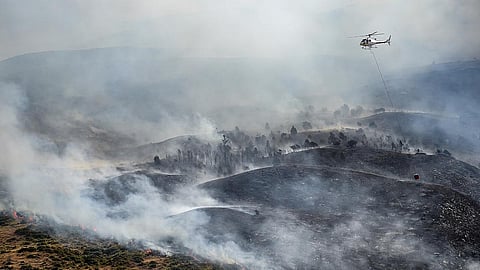

WEDNESDAY, Feb. 11, 2026 (HealthDay News) -- Wildfire smoke fine particulate matter (PM2.5) has a long-term impact on mortality and is associated with an increased mortality rate for all studied outcomes, according to a study published online Feb. 4 in Science Advances.
Min Zhang, Ph.D., from the Icahn School of Medicine at Mount Sinai in New York City, and colleagues estimated the effects of annual exposure to wildfire smoke PM2.5 on all-cause and cause-specific mortality in the contiguous United States from 2006 to 2020 using a doubly robust method, incorporating flexible generalized propensity score estimation that captured potential nonlinearity and interactions among confounders and relaxed the distribution form assumption for exposure.
The researchers found that for all studied outcomes except for deaths from transport accidents or falls, which served as negative outcome controls, wildfire smoke PM2.5 was associated with an increased mortality rate. In the contiguous United States, wildfire smoke PM2.5 was responsible for about 24,100 all-cause deaths per year. There was a monotonic increase in the exposure-response curve for all-cause mortality, with no evidence of a "safe" threshold. Of the six cause-specific outcomes, the greatest increase per 0.1-µg/m3 increase in smoke PM2.5 exposure was seen for neurological disease mortality.
"This study shows that long-term exposure to PM2.5 from wildfire smoke poses a growing and serious threat to public health nationwide," Zhang said in a statement.
